Evidence snapshot
- GLP-1
- Naturally occurring peptide hormone
- Semaglutide
- GLP-1 receptor agonist
- Tirzepatide
- Dual GIP/GLP-1 receptor agonist
- Regulation
- Varies by specific product and indication
Key takeaways
- GLP-1 is a peptide hormone that helps coordinate glucose regulation, insulin secretion, appetite, and food intake.
- Semaglutide is a GLP-1 receptor agonist; tirzepatide is a dual GIP/GLP-1 receptor agonist.
- Approved prescriptions, compounded products, investigational compounds, and products sold as research materials are not interchangeable.
What does GLP-1 mean?
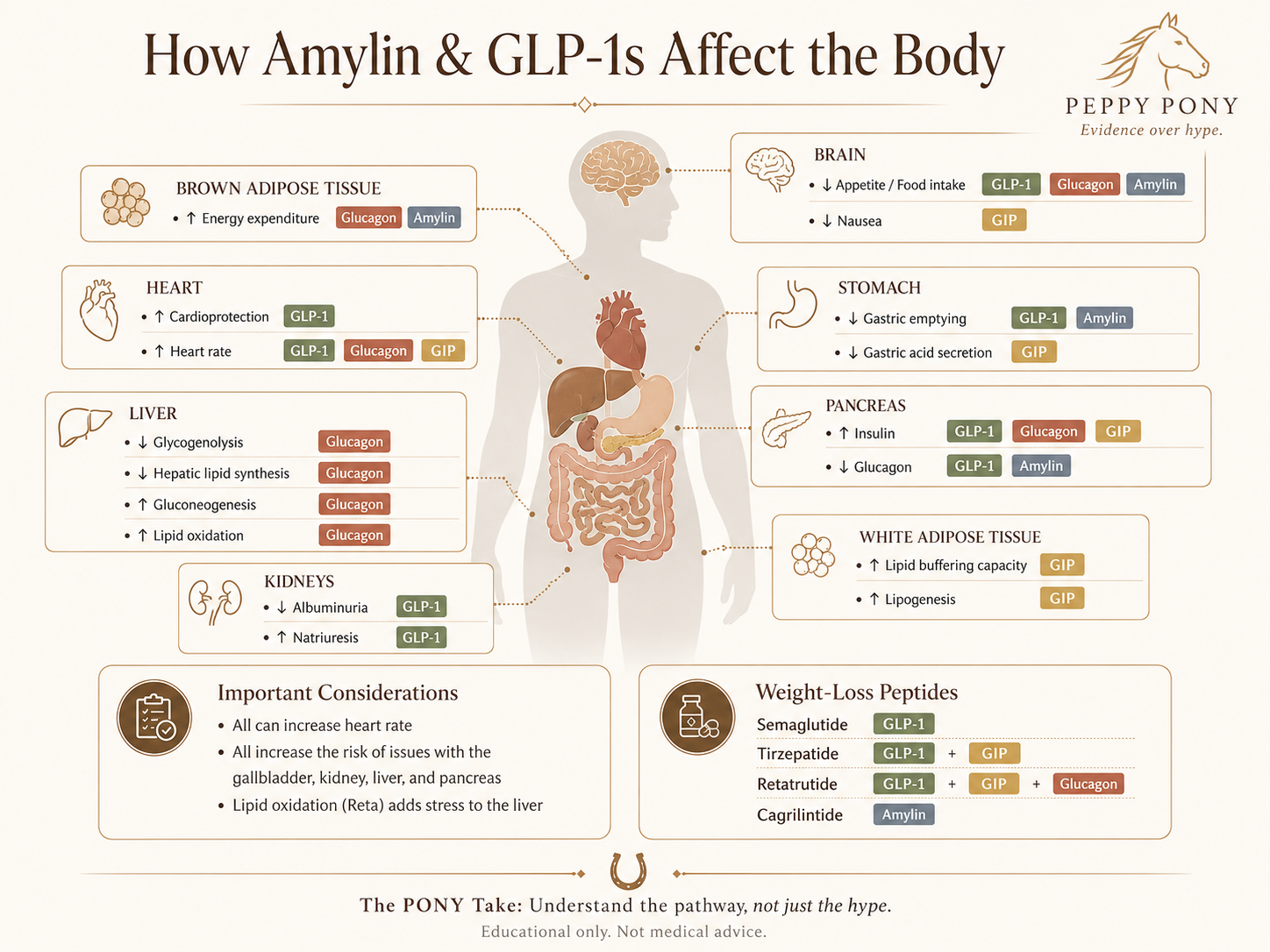
GLP-1 stands for glucagon-like peptide-1. It is a naturally occurring hormone involved in the body’s response to food. Among other actions, the GLP-1 system helps regulate blood glucose, glucose-dependent insulin secretion, appetite, and food intake.
Think of a receptor as a biological lock. GLP-1 is one of the keys. A GLP-1 receptor agonist is designed to activate that same signaling system, usually for much longer than the natural hormone remains active.
What do GLP-1 medicines do?
GLP-1 receptor agonists are used in the treatment of type 2 diabetes, and some products are approved for long-term weight management. By influencing glucose-dependent signaling, appetite, and food intake, these medicines act on metabolic pathways rather than on body weight alone.
Calling them simply “weight-loss drugs” leaves out important context. Approved uses, studied populations, dosing, benefits, and risks are specific to each product, and labels can change as new evidence is reviewed.
Semaglutide and tirzepatide
Semaglutide is a GLP-1 receptor agonist. It is the active ingredient in FDA-approved products including Ozempic, Rybelsus, and Wegovy. Wegovy has product-specific indications that include long-term weight management and cardiovascular risk reduction in certain populations.
Tirzepatide activates both the GLP-1 and GIP receptors. GIP stands for glucose-dependent insulinotropic polypeptide, so tirzepatide is described as a dual GIP/GLP-1 receptor agonist rather than a GLP-1-only medicine. It is the active ingredient in Mounjaro and Zepbound.
Why are GLP-1s getting attention?
Weight management made these medicines widely known, but incretin science extends beyond a number on the scale. Researchers and clinicians study these pathways in relation to appetite and satiety, blood glucose, insulin signaling, obesity, cardiovascular outcomes, and other metabolic diseases.
For example, FDA labeling includes semaglutide for reducing the risk of major cardiovascular events in certain adults with established cardiovascular disease and obesity or overweight. Other uses remain product- and population-specific.
Are all GLP-1 products the same?
No. FDA-approved prescription medicines, compounded products, investigational compounds, and products sold online as research materials are not interchangeable. A compound name alone does not establish approval status, manufacturing quality, purity, or safety and effectiveness for a particular use.
FDA warns that unapproved versions of semaglutide and tirzepatide do not undergo the agency’s premarket review for safety, effectiveness, and quality. Evidence over hype matters here: start with the biology, check the exact product, and follow current authoritative sources.
Visual guides
See the ideas together.
Open either graphic to view the full-size version.
Evidence, in proportion
What the evidence shows—and what it does not.
What it shows
- GLP-1 signaling participates in post-meal glucose regulation and can influence appetite and food intake.
- FDA-approved semaglutide and tirzepatide products have been evaluated for specific uses in defined populations.
- Some incretin-based medicines have product-specific indications beyond glucose control or long-term weight management.
What it does not show
- That every product described as a GLP-1 has the same active ingredient, approval status, quality, benefits, or risks.
- That activating the same receptor makes semaglutide, tirzepatide, compounded products, and investigational compounds interchangeable.
- That a general explanation can determine whether a prescription medication is appropriate for an individual.
The PONY takeaway
GLP-1 is a peptide hormone that helps coordinate glucose regulation, insulin secretion, appetite, and food intake. The remaining context determines how far that fact can travel.
Frequently asked
Common questions
What does GLP-1 stand for?+
GLP-1 stands for glucagon-like peptide-1, a naturally occurring hormone involved in metabolic signaling.
Are GLP-1s peptides?+
GLP-1 itself is a peptide hormone. Many medicines that activate the GLP-1 receptor are peptide-based drugs designed to produce longer-lasting effects than naturally occurring GLP-1.
Is semaglutide a GLP-1?+
Semaglutide is a GLP-1 receptor agonist: a medicine designed to activate the GLP-1 receptor.
Is tirzepatide a GLP-1?+
Tirzepatide activates the GLP-1 receptor, but it also activates the GIP receptor, making it a dual GIP/GLP-1 receptor agonist.
Do GLP-1 medicines reduce appetite?+
GLP-1 receptor agonists can reduce appetite and food intake, although effects and individual responses vary by product and person.
Are GLP-1 medicines only for weight loss?+
No. FDA-approved indications vary by medicine and product and include type 2 diabetes, long-term weight management, and certain additional product-specific uses.
Primary references
Sources
- FDA — Wegovy prescribing information
Current FDA labeling for semaglutide indications, mechanism, limitations, and safety information.
- FDA — Zepbound prescribing information
Current FDA labeling identifying tirzepatide as a dual GIP/GLP-1 receptor agonist and describing its approved uses.
- FDA — Concerns with unapproved GLP-1 drugs used for weight loss
FDA guidance on compounded, fraudulent, and other unapproved semaglutide and tirzepatide products.
- FDA — GLP-1 receptor agonist medication overview
FDA overview of approved GLP-1 receptor agonists, common mechanisms, and product distinctions.
This article is for general educational purposes only and is not medical advice. Prescription medicines should be used only under the supervision of a qualified healthcare professional. FDA approval, indications, contraindications, and regulatory status vary by specific product.